Home offices are no longer spare bedrooms with a laptop on a folding table. They’re dedicated workspaces that need real storage solutions. Office storage cabinets with drawers keep paperwork accessible, tools organized, and surfaces clear, all while fitting into tighter footprints than traditional filing systems. Whether someone’s working from home full-time or managing household admin one evening a week, the right cabinet setup eliminates clutter and actually gets used. This guide covers what works, what doesn’t, and how to pick and install cabinets that’ll last through years of daily use.
Table of Contents
ToggleKey Takeaways
- Office storage cabinets with drawers eliminate clutter by hiding visual mess, protecting documents from dust, and creating dedicated compartments for supplies—making them essential for functional home workspaces.
- Choose between vertical file cabinets for tight corners, lateral cabinets for wider accessibility, or mobile pedestals for flexible layouts; each serves different space constraints and storage needs.
- Invest in quality construction with plywood or steel materials and ball-bearing slides rated for 50–100+ lbs per drawer to ensure office storage cabinets with drawers last years without sagging or collapse.
- Proper installation includes leveling cabinets precisely, using anti-tip straps for vertical units over 30 inches tall, and securing wall-mounted units to studs with rated fasteners to prevent safety hazards.
- Test drawers under load and organize with dividers before fully loading; inspect slides for debris or misalignment to ensure smooth operation and long-term durability.
- Well-organized storage cabinets add perceived value to homes and make offices appear move-in ready, a benefit for resale in markets where remote work is common.
Why Office Storage Cabinets with Drawers Are Essential for Home Workspaces
Drawers outperform open shelving for office storage in almost every scenario. They hide visual clutter, protect documents from dust and sunlight, and lock when needed. A standard two-drawer file cabinet holds roughly 5,000 sheets of letter-size paper, enough capacity for most home offices without dominating floor space.
Cabinets with drawers also solve the “junk drawer” problem that kills productivity. Dedicated compartments for supplies, electronics, and reference materials mean less time hunting for a stapler or that one specific receipt. Drawer dividers and organizers can segment space down to the inch, turning a single drawer into a functional workspace for pens, cables, business cards, and charging stations.
From a resale perspective, built-in or quality freestanding storage cabinets add perceived value to a home office. Buyers notice functional workspace design, especially in markets where remote work is the norm. A well-organized office with proper storage reads as “move-in ready” compared to a room with cardboard boxes stacked in the corner.
Safety matters too. Cabinets with drawers rated for lateral load capacity (typically 50-100 lbs per drawer for quality units) won’t sag or collapse under the weight of heavy binders, tools, or reference books. Cheaper particleboard options often fail within two years of regular use, making upfront investment in plywood or steel construction a smarter long-term choice.
Types of Office Storage Cabinets with Drawers
Vertical File Cabinets
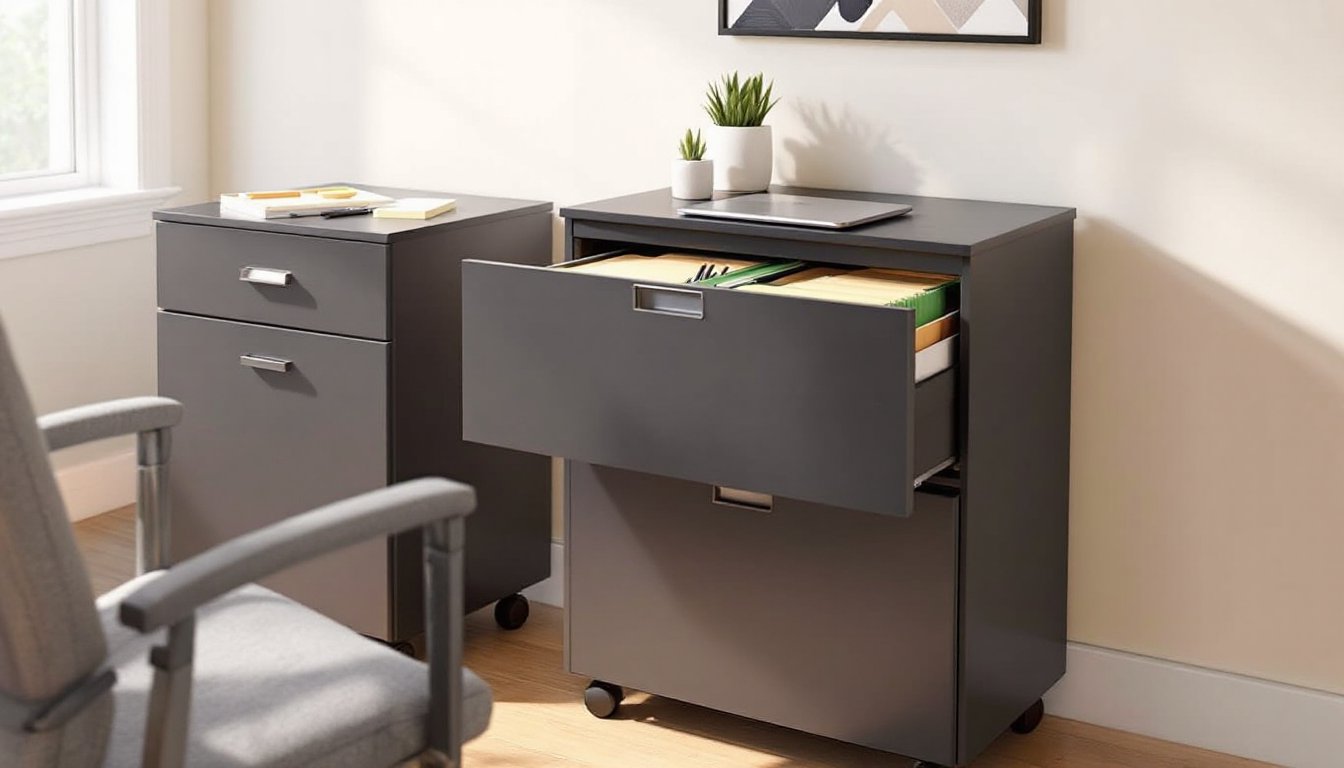
Vertical file cabinets are the classic two-, three-, or four-drawer units that stand 28-52 inches tall and occupy about 15 x 25 inches of floor space. They’re ideal for tight corners or alongside desks in smaller home offices. Most accept letter- or legal-size hanging file folders, with full-extension drawer slides that allow access to the back of the drawer without removing contents.
Steel vertical cabinets dominate commercial settings and hold up better than wood or laminate options for heavy daily use. Look for units with ball-bearing slides rather than roller slides, they handle weight better and last longer. Anti-tip features are mandatory: vertical cabinets become top-heavy when the upper drawer is fully loaded and extended. Many jurisdictions’ building codes (based on ANSI/BIFMA standards) now require interlock systems that prevent more than one drawer from opening at a time.
Wood or wood-veneer vertical cabinets work when aesthetics matter more than industrial durability. They blend into residential interiors better than gray steel but often cost 30-50% more for comparable storage capacity. Expect 3/4-inch plywood construction for anything worth keeping, particleboard cores won’t survive a move or years of drawer cycling.
Lateral File Cabinets
Lateral file cabinets run 30-42 inches wide and 18-20 inches deep, with drawers that pull out the width of the cabinet rather than the depth. This design puts more files within arm’s reach without requiring the user to dig through front-to-back rows. They’re a better fit under windows, along walls, or behind desks where vertical height is limited.
Two-drawer lateral units double as credenzas when topped with a work surface or printer. The shallower depth (compared to vertical units) means they don’t jut as far into walkways, critical in home offices converted from bedrooms or basements. Drawer configuration matters: some laterals use side-to-side hanging file rails, others front-to-back. Side-to-side setups allow users to organize filing systems with fewer folders per row, improving visibility.
Load ratings run higher on lateral cabinets because drawer weight distributes across wider slide mechanisms. Quality units handle 100+ lbs per drawer, enough for mixed media storage, binders, books, and equipment. Steel models often include integrated drawer label holders, a small detail that prevents tape residue and makes reorganization cleaner.
Mobile Storage Cabinets
Mobile storage cabinets (often called pedestals or rolling file cabinets) range from compact two-drawer units to larger three-drawer models, all mounted on locking casters. They tuck under desks when not in use and roll out for access, saving fixed floor space in cramped layouts. Standard dimensions run about 15-18 inches wide, 20-24 inches deep, and 24-28 inches tall.
Caster quality separates usable mobile cabinets from frustrating ones. Look for 3-inch hard rubber or polyurethane wheels with dual-locking mechanisms (wheel rotation and swivel). Cheap plastic casters crack under load and mar hardwood or tile floors. Metal mobile cabinets outlast laminate or plastic shells, especially in spaces where the unit gets moved daily.
Drawer depth varies widely in mobile cabinets. Shallow top drawers (3-4 inches) work for office supplies: deeper file drawers (10-12 inches) accommodate hanging folders. Some models include a cushioned top that doubles as seating, helpful in workshop or garage office setups where extra chairs don’t fit. Editor-tested options often highlight mobile units for flexibility in multi-use spaces.
How to Choose the Right Office Storage Cabinet for Your Space
Start with measurements, not aesthetics. Measure the installation spot (width, depth, and overhead clearance), then measure doorways and stairwells between the delivery point and the office. A 36-inch-wide lateral cabinet won’t make it through a 32-inch door without disassembly, and many pre-assembled steel cabinets don’t come apart.
Match drawer depth to what’s being stored. Letter-size files need a minimum 12-inch interior depth: legal-size requires 15 inches. Storing binders, parts bins, or tools? Box drawers (non-file drawers without hanging rails) offer more flexibility but won’t accommodate standard hanging file folders without aftermarket frames.
Consider weight distribution and floor load, especially in older homes or spaces above basements. A fully loaded four-drawer steel vertical cabinet weighs 300-400 lbs. If the office sits on a second floor with 2×8 joists on 16-inch centers, that load concentrates on a single joist. Spreading weight with a broader-footprint lateral cabinet or placing the unit perpendicular to joist direction reduces deflection risk.
Locking mechanisms matter for household security and compliance. Cabinets storing financial documents, medical records, or client data may require keyed locks to meet privacy regulations (HIPAA, GDPR-adjacent state laws). Core-removable locks allow rekeying without replacing the entire cabinet, useful if keys get lost or the office changes hands.
Finish and material should match the room’s use pattern. Powder-coated steel handles moisture better in basements: wood veneers suit climate-controlled main-floor offices. Laminate and melamine finishes resist scratches but chip at edges under impact. If the office doubles as a workshop or project space, prioritize durability over appearance.
DIY Installation and Setup Tips for Office Storage Cabinets
Most freestanding office storage cabinets require minimal assembly, attaching drawer pulls, installing casters, or mounting locking bars. Read the instructions fully before starting: some manufacturers ship cabinets with drawers removed to prevent slide damage during shipping, and reinstalling them in the wrong sequence can jam the interlock system.
Leveling is non-negotiable. Even a 1/4-inch slope causes drawers to drift open or closed on their own. Use a 4-foot level on top of the cabinet (front-to-back and side-to-side) and adjust with shims under the base or leveling feet if included. On carpet, place a 3/4-inch plywood platform under the cabinet to prevent sinking and keep drawers aligned. Platform dimensions should match or slightly exceed the cabinet footprint.
For wall-mounted or built-in drawer units, locate studs with a stud finder and use appropriate fasteners. A typical wall-mounted file drawer cabinet weighs 50-80 lbs empty and doubles when loaded. Mounting to drywall alone invites failure. Use 3-inch #10 wood screws into studs or toggle bolts rated for 100+ lbs in hollow walls, with at least two fasteners per cabinet.
Anti-tip straps or brackets are required for vertical cabinets over 30 inches tall, per ANSI/BIFMA X5.9 standards. These L-brackets mount to the top back of the cabinet and anchor into wall studs, preventing tip-over if a child (or adult) pulls multiple drawers open simultaneously. Skip this step and the cabinet becomes a 300-lb hazard.
Drawer organization comes next. Install dividers, trays, or hanging file rails before loading contents. Adjustable dividers cost $10-30 and transform a catch-all drawer into a segmented system. For hanging files, confirm the rail width matches the file size, letter rails won’t support legal folders, and mixing them creates friction that jams drawers.
If installing multiple cabinets, gang them together with cabinet connector bolts (1/4-inch x 2-inch bolts with flat washers). This creates a single, more stable unit and prevents gaps where items fall through. It’s especially useful for lateral cabinets placed side-by-side to form a credenza run.
Safety gear: Wear work gloves when handling steel cabinets (sharp edges and pinch points abound) and safety glasses if drilling into walls or cutting plywood platforms. Keep a cordless drill, level, tape measure, stud finder, and Phillips/flat-head screwdrivers on hand. A rubber mallet helps seat drawer slides without marring finishes.
Test drawers under load before calling the job done. Fill the bottom drawer first (lowest center of gravity) and work upward, checking that slides extend fully and lock in place. If a drawer binds or won’t close flush, remove it and inspect the slides for debris, misalignment, or shipping damage. Most slide issues resolve by loosening mounting screws, realigning the slide, and retightening.
For cabinets in unfinished basements or garages, apply a rust-inhibiting spray to steel hardware annually. It takes ten minutes and extends service life in humid environments. Wood cabinets benefit from occasional furniture wax or polish, not for looks, but to seal the finish and prevent moisture absorption that leads to drawer swelling.