A cluttered office isn’t just an eyesore, it’s a productivity killer. Papers stack up, supplies vanish into drawers, and finding what you need feels like an archeological dig. The solution isn’t buying more desk organizers or filing trays: it’s investing in proper office storage cupboards that give everything a designated home. Whether someone’s building out a home office in a spare bedroom or upgrading a basement workspace, the right storage cupboards can transform chaos into a functional, efficient environment. This guide breaks down cupboard types, selection criteria, and installation tips to help anyone create a workspace that actually works.
Table of Contents
ToggleKey Takeaways
- Office storage cupboards eliminate wasted search time by providing designated homes for supplies and documents, with workers recovering an average of 4.3 hours per week in productivity.
- Different cupboard types serve different needs: tall cabinets maximize vertical space, lateral file cupboards handle document storage efficiently, and wall-mounted units preserve floor space in smaller offices.
- Proper installation requires locating wall studs, leveling cabinets with shims, and anchoring tall units with L-brackets or French cleats to prevent tip-over and ensure long-term stability.
- Material selection impacts durability and cost—particleboard suits light-duty storage, plywood handles heavier loads, and metal cabinets offer maximum durability and fire resistance for valuable documents.
- Frequently accessed supplies belong in base or lower shelves at waist-to-shoulder height, while archived items can be stored higher, with anything above 72 inches requiring a step stool for access.
- Pre-installation preparation, including allowing cabinets to acclimate for 24-48 hours, prevents moisture-related issues like door misalignment and drawer binding in your office workspace.
Why Office Storage Cupboards Are Essential for Productivity
Productivity research consistently shows that physical clutter drains mental energy. When office supplies, documents, and equipment lack dedicated storage, workers waste an average of 4.3 hours per week searching for items, time that could be spent on actual work.
Office storage cupboards solve this by creating vertical storage zones that keep items accessible but out of sight. Unlike open shelving, which displays everything and collects dust, cupboards with doors hide visual clutter while protecting contents from light damage and debris. This is particularly important for storing printer paper, which can yellow under prolonged UV exposure, or sensitive documents that need protection from airborne particulates.
From a workspace design perspective, cupboards also define zones. A tall storage cabinet along one wall establishes a boundary between work areas and storage areas, making even a multi-purpose room feel more organized. For tax preparers, freelancers, or anyone managing client files, lockable cupboards provide security that open storage can’t match, a consideration that’s often code-required for certain professions handling confidential information.
The ergonomic benefit is real too. Properly installed cupboards at appropriate heights (base units at 34½ inches, wall units with bottom shelves at 54-60 inches) reduce repetitive bending and reaching, which contributes to long-term musculoskeletal health for anyone spending 40+ hours weekly in their office.
Types of Office Storage Cupboards for Every Workspace
Tall Storage Cabinets
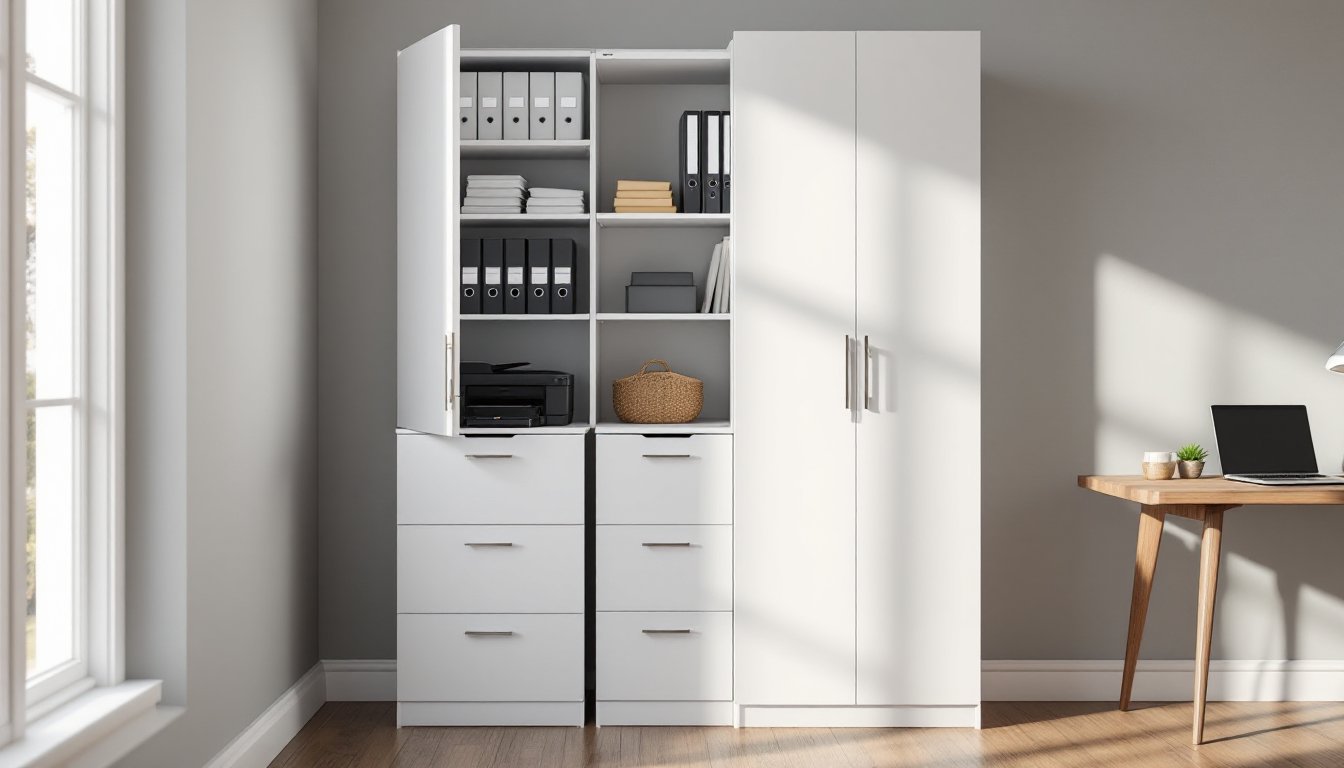
These floor-to-ceiling units (72-84 inches tall) maximize vertical space without consuming much floor area. A standard tall cabinet measures 24 inches deep and 30-36 inches wide, offering 6-8 adjustable shelves that can hold everything from reams of paper to reference binders.
Tall cabinets work best in corners or along walls that don’t have windows. They’re ideal for storing bulk office supplies, archived files, or equipment like printers and scanners on pull-out shelves. Many units include a combination of fixed shelving in upper sections and drawers or pull-out trays below, useful for organizing smaller items like pens, staplers, and charging cables.
One construction note: any cabinet over 72 inches tall should be anchored to wall studs using L-brackets or a French cleat system to prevent tip-over, especially in earthquake-prone regions. The IRC doesn’t mandate furniture anchoring in offices, but it’s standard practice and takes only 15 minutes with a stud finder and 3-inch wood screws.
Lateral File Cupboards
Lateral file cabinets are the workhorses of document storage. Unlike vertical files that require deep drawer pulls, lateral units pull straight out and allow side-to-side filing, making it easier to see folder tabs at a glance. Standard dimensions run 30-42 inches wide, 18-20 inches deep, and 28-67 inches tall depending on the number of drawers.
These cupboards typically hold letter- or legal-size hanging folders and are built heavier than standard cabinets, expect 12-gauge to 16-gauge steel in commercial-grade units. That weight matters: a fully loaded four-drawer lateral file can exceed 400 pounds, so installation on anything but a concrete slab or over floor joists (not just subfloor) is critical.
For home offices, a two-drawer lateral file at 28 inches tall doubles as a printer stand or secondary work surface. It’s a space-efficient option that many organizing experts recommend for managing both active and archived paperwork without occupying excessive square footage.
Wall-Mounted Storage Units
Wall-mounted cupboards free up floor space entirely, making them ideal for small home offices or shared workspaces. These units typically measure 12-15 inches deep (shallower than base cabinets) and 30-48 inches wide, mounted 54-60 inches from the floor to the bottom edge so they clear a standard desk height of 29-30 inches.
Installation requires locating studs, 16 inches on center in most residential framing, and using appropriate fasteners. For a unit holding books or heavy binders, use 2½-inch cabinet screws into studs, or toggle bolts rated for the load if studs aren’t positioned where needed. A loaded wall cabinet can weigh 100+ pounds, so this isn’t a drywall-anchor situation.
Wall-mounted units with sliding or lift-up doors work well in tight quarters where swing-out doors would block pathways. They’re also popular in standing-desk setups, where floor cabinets would interfere with leg positioning.
Choosing the Right Office Storage Cupboard for Your Space
Start by measuring the room, not just width and length, but ceiling height, door swing clearances, and existing furniture footprints. A tall cabinet sounds great until it blocks a window or makes a small room feel like a closet. For rooms under 100 square feet, prioritize wall-mounted or lateral units that maintain open floor space.
Consider what’s being stored and how often it’s accessed. Frequently used supplies (printer paper, folders, pens) belong in base cabinets or the lower shelves of tall units at waist to shoulder height. Archive boxes and seldom-used items can go higher. Anything stored above 72 inches will likely require a step stool, which discourages regular use, fine for tax records from 2019, problematic for the label maker.
Material choice affects both durability and cost. Particleboard with melamine coating is budget-friendly and fine for light-duty storage, but it doesn’t handle moisture well and can sag under heavy loads (over 30 pounds per linear foot). Plywood construction costs 20-30% more but supports heavier loads and stands up better in basements or garages where humidity fluctuates. Metal cabinets, especially those meeting ANSI/BIFMA standards, are the most durable and fire-resistant option, worth considering for document storage in home-based businesses.
Door style impacts function too. Swing doors require clearance (usually 24-30 inches in front of the cabinet). Sliding doors save space but only allow access to half the interior at a time. Roll-up tambour doors (common on lateral files) are a middle ground, though the tracks can jam if overloaded.
For those working with limited budgets or unconventional spaces, IKEA furniture modifications offer clever ways to adapt affordable cabinets for specific office needs, adding casters for mobility, modifying shelf spacing, or combining units for custom configurations.
DIY Office Storage Cupboard Installation Tips
Preparation is non-negotiable. Before assembly or installation, let cabinets acclimate to room temperature and humidity for 24-48 hours. This is especially critical for wood or engineered wood products, which expand and contract with moisture changes. Skipping this step can result in doors that won’t close properly or drawers that bind.
Tools you’ll need:
- Stud finder (magnetic or electronic)
- Level (24-inch or 48-inch depending on cabinet size)
- Drill/driver with Phillips and square bits
- Measuring tape
- Pencil
- Shims (for leveling)
- Safety glasses
Step-by-step installation for wall-mounted units:
- Mark the desired height on the wall (typically 54 inches to bottom edge).
- Locate studs with a stud finder and mark centers with a pencil.
- Measure and mark where cabinet mounting rails or brackets will align with studs.
- Pre-drill pilot holes to prevent splitting, use a bit 1/64 inch smaller than screw diameter.
- Attach mounting rails or French cleats to studs using 2½-inch cabinet screws.
- Hang the cabinet with a helper, these are awkward and tip-prone solo.
- Check level in both directions (side-to-side and front-to-back) and adjust with shims if needed.
- Secure cabinet to mounting system per manufacturer specs.
For floor-standing cabinets:
Start by checking floor level. Rarely are floors perfectly flat. Place a 48-inch level across multiple directions and note high/low spots. Use plastic shims (not wood, which compresses over time) under cabinet bases to achieve level. An unlevel cabinet will have doors that swing open or won’t close, annoying enough that most people just live with it instead of fixing it.
If installing multiple units side-by-side (like modular storage systems), clamp them together before securing to the wall. Drill through cabinet sides and use 1¼-inch cabinet connector bolts to join units. This creates one stable assembly rather than several independent pieces that can shift over time.
Anchoring is critical: Use L-brackets at the top rear corners, screwed into both the cabinet and wall studs. For tall or heavy units, add a second set of brackets midway down the back. This prevents tip-over if drawers are opened simultaneously or if someone (or a pet) climbs on lower shelves.
Safety notes: Wear safety glasses during drilling, drywall dust and wood chips fly unpredictably. If cutting or modifying cabinets, use a dust mask rated N95 or higher and work in a ventilated area. Engineered wood products can contain formaldehyde-based adhesives that release fine particles when cut.
Don’t over-tighten screws, especially into particleboard or MDF. These materials strip easily. Snug is sufficient, if the screw stops advancing, stop turning. Stripped holes can be salvaged with wood glue and toothpicks as a temporary fix, but it’s better to avoid the problem.
If running power for interior cabinet lighting or charging stations, consult the NEC (National Electrical Code) for low-voltage wiring requirements, or hire a licensed electrician. Even low-voltage LED strips require proper connections to avoid fire hazards, and some jurisdictions require permits for any in-wall electrical work.